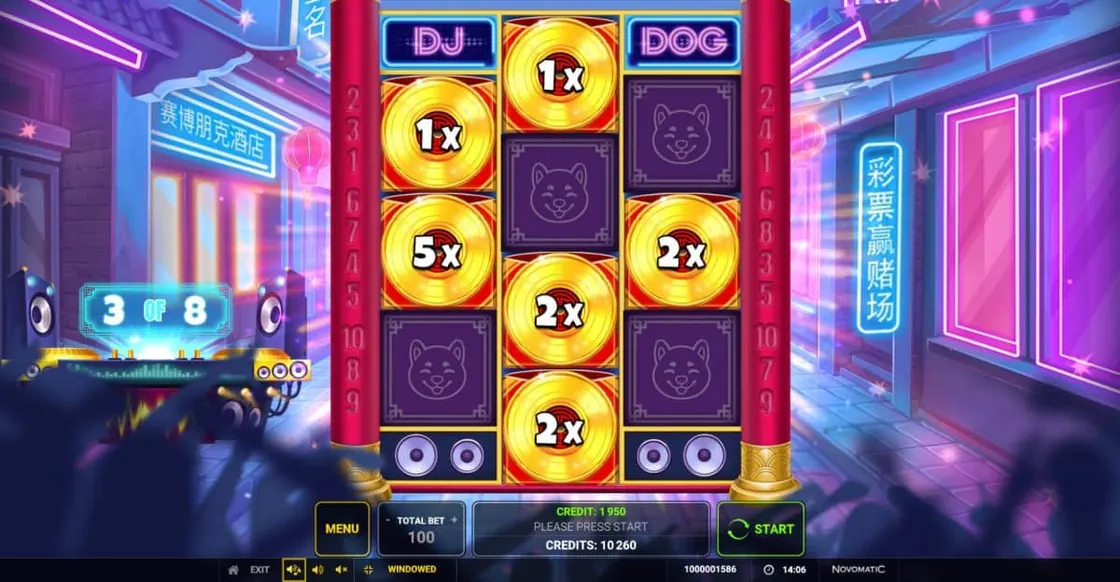
DJ Dog mechanics: how a spin on the 3x4x3 grid resolves
Ten win lines across a grid that is three symbols deep, then four, then three. That is the whole frame, and the studio publishes it in one sentence. What happens inside it is a count, not a pattern.
The two red columns carry the line indicators; the middle reel is one position taller than its neighbours, which is what the uneven grid means in practice.
How the game plays, position by position
The grid is not a rectangle. Reel one shows three positions, reel two shows four, reel three shows three again — ten cells in all, with the middle column standing a step taller than the two beside it. In our capture the two red pillars flanking the reels carry the line indicators, numbered down both sides, which is how ten lines are made to fit a frame this small without crowding it.
Ten cells and ten lines is a tight ratio, and it is the reason this game reads instantly. There is no scrolling matrix to scan and no cascade to wait out. A spin stops, the grid is complete, and everything that will be considered is on screen at once.
The uneven shape has one practical effect worth knowing. The tallest column is the middle one, so the centre of the screen holds more than either edge — your eye goes to the right place by default, and the fifth disc you are counting towards is more often than not somewhere in that column.
The frame, as the studio states it
Four lines, one source. Greentube's page for this title gives all of them in a single sentence, which is why nothing in this block carries a second attribution.
Reels
three
studio page
Grid
3x4x3 positions
studio page
Lines
ten
studio page
Pay trigger
five or more records
studio page
What makes a spin pay
The studio's rule is one sentence and it does not have exceptions in the base game: five or more golden records on the grid pay the values they carry. Not five on a line. Five on the grid, wherever they fall, with each paying what is printed on it.
That turns the ten win lines into something quieter than the headline number suggests. They are the frame the game is built in and the thing the indicators down the pillars are counting, but the moment that decides whether a spin has paid is a head-count of discs. Both facts are the studio's; they sit in the same sentence on its page.
This is worth being precise about because it changes what a player watches. In a line game the eye follows shapes left to right and a near miss is a pattern that almost completed. Here a near miss is a number: four records, one short. The game is readable by anyone, including someone who has never thought about a payline in their life.
One rule, both halves of the game
The studio repeats the paying rule when it describes Lucky Spins, and it repeats it unchanged: like in the base game, five or more records pay the values they carry. The feature does not introduce a second arithmetic, a multiplier ladder, a sticky mechanic or a progressive anything.
What it changes is what else can appear, and the answer is nothing. For eight spins the reels hold records and blank positions only. The same question — is that five yet — is being asked against a grid with the clutter removed.
A design note that explains the rest of the game: because the feature is the base game minus distractions, the base game has to be worth watching on its own. That is what the printed values on the discs are for, and it is why the symbol set outside the records is deliberately flat and unremarkable.
What is not published about the maths
Greentube's page gives the frame and the rule and stops. It does not publish a return to player, a hit frequency, a ladder of record values or a volatility rating in words, and our own product notes name no percentage either. One catalogue fills the first gap: the figure is 95%, and it is SlotCatalog's figure, and that same catalogue states the grid as 3-4-3, which is at least a page describing this game.
A second percentage is in circulation and is deliberately not quoted on this site. The listing carrying it gives the game five reels, credits it to a different studio, dates it two years early and describes a feature built on scatters, sticky wilds and a climbing multiplier. That is not a dissenting measurement of this game's return; it is a number attached to the wrong product. Printing it next to the catalogue's would present it as a second opinion, which is precisely the weight it does not deserve.
The ceiling comes from the same catalogue, at 10,000× the stake, and so does the stake range: 0.10 to 50. Neither is confirmed by the studio. The game's own information panel at whichever operator you are at is the only copy of these numbers that describes the build in front of you.
Volatility is a third case, and an instructive one. The studio's own play-for-fun site labels this game mid-high; the catalogue labels it high; and the studio's game page shows the rating as a row of marks rather than as a word at all. Nobody is lying — a rating drawn as four marks has to be turned into English by whoever is quoting it, and two people will not always choose the same word.
Questions about how it resolves
Answered from the studio's page where it says anything, and marked where it does not.
Is the grid really uneven?
Yes. The studio states a 3x4x3 grid on three reels: three positions on the outer reels and four in the middle, ten cells in total.
Do records have to land on a line?
No. The rule is five or more records on the grid, each paying the value it carries. The ten lines are the frame the game is built in.
Does the feature change the paying rule?
No. The studio repeats it word for word for Lucky Spins and changes only what else can land, which during the feature is nothing but blanks.
What top win does a catalogue list for the Dj Dog slot?
A catalogue states ten thousand times the stake. The studio publishes no ceiling of its own, so the figure is that catalogue's rather than ours.
The feature has a page of its own next: when it can start, what it does to the reels, and the one thing the studio rules out about it.