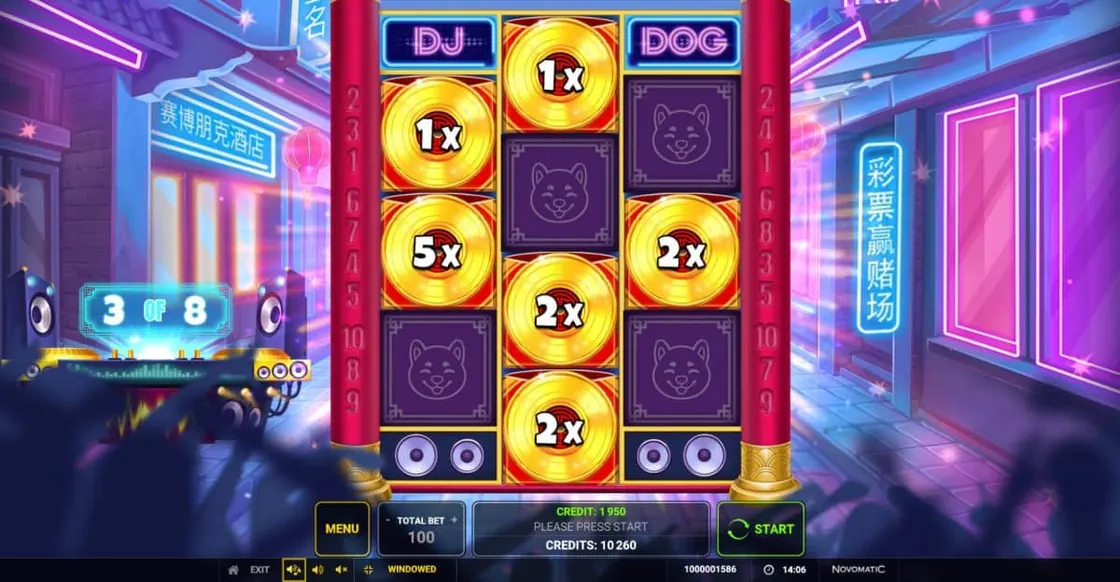
DJ Dog symbols: the golden record, the mystery record and the blanks
This is a short symbol set doing an unusual job. The paying object is not a line of matching faces — it is a disc with a number printed on it, and the game asks you to count the discs rather than read a paytable.
Six discs on screen carrying 1x, 2x and 5x, dog faces filling the rest of the grid, and the feature counter reading three of eight on the left.
The golden record, and why it is not a normal symbol
A conventional slot symbol means something only in company: three cherries on a line are worth looking up, one cherry is worth nothing. A golden record here is different. It arrives with its own figure stamped across it, so its worth is legible the instant it lands, before any line is evaluated and before any total appears.
What the record needs is not matching neighbours but a quorum. The studio's rule is five or more of them on the grid, at which point every disc on screen pays the value it is carrying. The question a player is asking during a spin is therefore arithmetic rather than pattern recognition: not did a line form but is that five yet.
In our capture of the running game the discs show 1x, 2x and 5x. Those are the values that happened to land on that spin, not a published ladder — the studio does not publish the set of values a record can carry, and this site does not invent one. The behaviour is the fact; the particular numbers are a sample.
What is on the reels
The studio names the first two outright. The rest is what our own capture of the running game shows, and it is labelled as such.
Golden record
carries a printed value
studio page
Mystery record
pays especially big
studio page
Blank position
lands during the feature
studio page
Dog faces
fill the rest of the grid
our own capture
Values seen
1x, 2x and 5x
our own capture
The mystery record
The studio singles out one disc and calls it elusive: a mystery record that will pay especially big wins. It says nothing further — no frequency, no value, no rule about how it resolves, no statement about whether it is part of the five-record count or additional to it.
That is where the honest account of this symbol ends. A catalogue entry lists a mystery symbol among the game's features, which corroborates that it exists without adding anything about what it does. Nobody publishes a figure for it, so there is no figure here.
What can be said usefully: a game that already prints a value on every paying object has an obvious gap to exploit, which is an object whose value is not printed until the moment it matters. That is the shape of the thing. It is also the single element in this game you cannot read off the screen in advance, which is presumably the point.
The blanks, and the dogs behind them
Blank positions are not usually worth a paragraph. Here they are, because the studio names them. During Lucky Spins the only two things that can land are records and blanks — the blank is promoted from background to half the feature's content, and the empty cell becomes the thing standing between a spin and its fifth disc.
In the base game the grid is filled out by the dog faces: flat, dark-framed tiles with a shiba head on them, several variants of the same idea. They are the ordinary symbol set and the studio does not describe them, so neither will this page beyond what is visible — they occupy the positions a record is not occupying, and during the feature they are gone entirely.
The contrast between the two screens is the clearest thing in the game. A base-game grid is busy: faces everywhere, a record or two among them. A feature grid is mostly empty space with discs in it. You can tell which mode you are in from across a room, which is more than can be said for most free-spin rounds.
What a printed value does to a symbol set
It is worth sitting with the consequence of putting the figure on the object, because it quietly removes three things most slots need. It removes the paytable as a thing you have to consult, since the only number that matters is already on screen. It removes the hierarchy of high and low symbols, since there is no ladder of faces to rank. And it removes the tension of the left-to-right reveal, since nothing is being completed from one edge of the grid to the other.
What it puts back is a single, very legible question. Five discs or not five discs. A player who has never seen the game before can be told the whole paying rule in one sentence and will then read every subsequent spin correctly, which is not something that can be said of a game whose symbol set has nine tiers and three special cases.
The cost is that the ordinary symbols have very little to do. The dog tiles are not competing for your attention; they are the texture that makes a grid with two discs on it look different from a grid with five. That is a legitimate job, and it explains why they are drawn flat and dark while the records are the only bright objects on the reels.
It also explains the one deliberate hole in the design. If every paying object announces its value in advance, nothing is ever a surprise — so the studio keeps one disc back whose worth is not legible until it resolves. The mystery record is the only thing on these reels that can still be unexpected, which is a lot of weight for a symbol nobody publishes a figure for.
Questions about the symbol set
What the studio states, and where it stops.
How many records are needed to pay?
Five or more on the grid. Each one then pays the value printed on it, in the base game and during Lucky Spins alike.
What values can a record carry?
The studio does not publish the set. Our own capture of the game shows discs carrying 1x, 2x and 5x, which is a sample rather than the full ladder.
What is the mystery record?
A rarer disc the studio describes only as elusive and as paying especially big wins. No value, frequency or resolution rule is published for it.
Why do blank positions matter?
Because during Lucky Spins they are half the content: the studio states that only records and blank symbols can land for the eight spins.
How those discs turn into a paid spin is the next page, together with the grid they land on and the ten lines drawn across it.